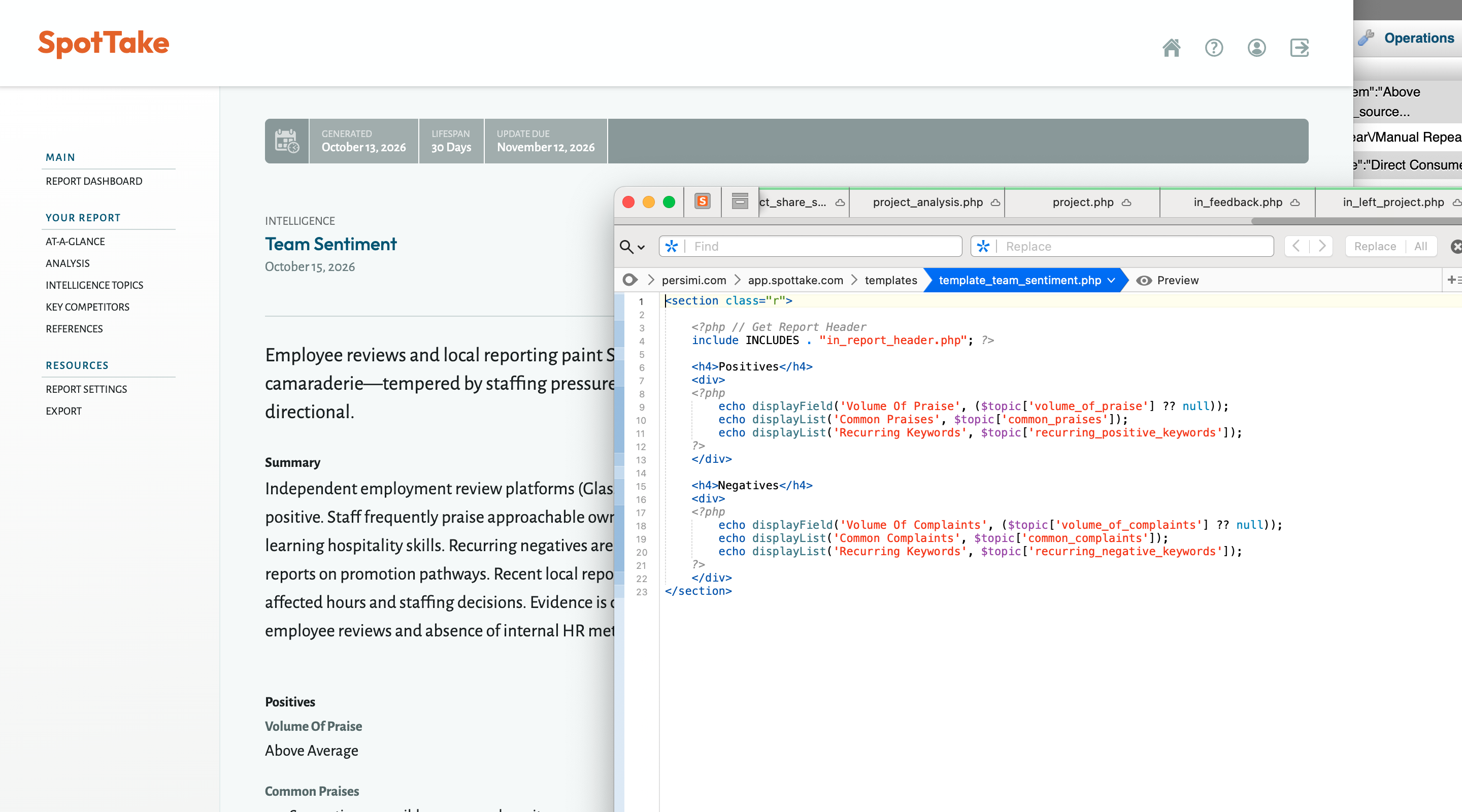
With AI poised to reinvent digital products and the way they're made, I decided the best way to understand what it meant for businesses, product teams, and customers was to experience it firsthand.
Another Technological Sea Change
I've lived and led through a few technological revolutions. When I started in UX it was just 'design'. Most people didn't have a home computer. Most of those who did weren't online. Email was still unfamiliar to the vast majority of people.
This was the early 1990s. In the years that followed, the Information Age changed everything.
AI looks poised to change it again.
I've embraced the emergence of AI while being cognizant of its dangers. But I also believe that leading or advising in a technology role comes with a deeper responsibility to understand it. I didn't think reading about AI, or attending any number of meetings would be enough. I wanted to take on a wide range of roles in the process and get a sense of what AI meant across to the tangible realities of those involved.
The Customer Role
The most important role to understand was that of the customer. I needed a product that I would personally use.
After an Odyssey of exploration, I landed on the idea that has become SpotTake: a product that gathers publicly available information scattered across the web, organizes it into readable business intelligence, and helps people understand what it might mean.
I had no illusions about competing with enterprise business intelligence platforms. But I saw an opportunity among small businesses, startups, and agencies. Most business intelligence channels present barriers to entry that customers at this level can't easily overcome.
A Product to Fit the Customer
I found that a defining characteristic of small business is the weight carried on the owners' shoulders. It's a weight that makes time, attention, and energy into critical resources as valuable and scarce as money. Even a free product is expensive when it demands time and attention you don't have.
Even a free product is expensive when it demands time and attention you don't have.
It became a defining requirement for SpotTake to be uniquely usable. It needed to be fast, simple, and hassle-free. No complicated setup. No new workflow to learn.
I began experimenting with a series of AI prompts, dynamically structured to get core information from a URL and then use that information to further search the web. And just like that SpotTake began to take shape. With nothing more than a URL, I had a rudimentary system of returning a vast amount of data, sourced from a vast array of references.
Making Something Real
There's no shortage of hype around the idea that AI can build an app in a day. It can, but it's highly unlikely to be a product anyone would want to use.
Getting a software prototype to successfully produce a valuable output is different from building a product people can rely on.
The decisions you make getting to the first draft are large-scale decisions with broad influences, and there's fewer of them. Though they're big, the broadness of their influences tends to make them easy decisions. As a product matures, the decisions become smaller, with very specific influences, and there are exponentially more of them. You go from 'Can I get an app to do this' to 'How do I make this flow intuitive to the user?', 'What is the right back-end architecture for scalability?', 'How should I handle account management, refunds, and email outreach' to name a very, very few.
Ask an AI to build you an app, you'll get an app. Ask an AI to answer any of the smaller questions, and you'll spend a considerable amount of time providing context and appreciating the value of expertise in the related fields. You can't get an answer to a question you don't have the expertise to ask.
You can't get an answer to a question you don't have the expertise to ask.
Lessons Learned
As SpotTake evolved as a product, the challenges became less about AI producing useful intelligence and analysis, and more about how the value of that information was strongly dependent on the way it was made available.
The best example concerns trust.
It was immediately clear that information presented by AI came with an obligation to earn the user's trust. This has always been partially true in any information-delivery system, but its magnified in use cases involving AI. Information is perceived as fragile and suspect, and the user feels suspicious of the channel in being asked to take it at face value. The experience is a net negative.
To address this, I built designed and built SpotTake to present information with a confidence assessment, a list of the information gaps it could not fill in its search, and to provides direct links to every source it finds. The humility and transparency of inviting validation in such a prominent way puts the associated information in dependable context for the user. It allows them to use SpotTake not just as an information dump, but as a tool to gain the confidence they need through initial discovery, analysis, and then as much validation as they require, with open doors to the sources they'll need.
The Fundamental Realization
I found that the fundamentals haven't changed. And I think it'll be a long time before they do. The creation of digital products is complex work with fuzzy edges and ever-changing context. It's a difficult job. AI can relieve a lot of the difficulty. But it can't relieve us of the responsibility to do the job well.